2026
Two people. Weeks, not months. A shipped AI product in regulated fintech.
Moonshot — AI-powered distribution hub for fund managers.
I shipped Moonshot with one collaborator — a data engineer — inside a regulated financial services environment, in weeks not months. AI was the tool at every layer: sourcing leads, scoring them, designing the interface, writing the code. The whole system runs on VentureCrowd's shared Salesforce infrastructure.
The problem
Fund managers were sourcing investors in spreadsheets.
VentureCrowd identified a gap in the Australian private markets industry: fund managers were still sourcing investors manually through fragmented workflows like LinkedIn prospecting, spreadsheets, and broad campaign distribution.
At the same time, increasing DDO compliance obligations created pressure for more transparent and defensible investor targeting practices. Existing tools either broadcast opportunities broadly or relied on simplistic filtering, creating operational and compliance risk.
The opportunity was to create a scalable AI-powered distribution platform that could help fund managers discover, prioritise, and engage suitable investors more efficiently.
Why Moonshot
Why we called it Moonshot.
A cultural bet, not just a project name.
The name wasn't accidental. Moonshot was a deliberate cultural bet — a project chosen specifically to prove that VentureCrowd could move differently: faster, leaner, without sacrificing compliance or quality. Two of us — a data engineer and me, with no prior production React experience — compressed a delivery lifecycle that typically runs to months into a matter of weeks. AI was the tool that made it possible.
Before
Traditional workflow
After
New workflow
I had no prior React experience when the project started. Within weeks I was shipping production-ready frontend in Next.js using Claude Code — designing directly in code, skipping the handoff gap entirely. Engineering reviewed and merged. No separate build phase.
Key design challenges
Three tensions to design through.
Building an AI product in a regulated financial environment: trust, guidance, and compliance each pulled in a different direction.
Designing trust into AI scoring.
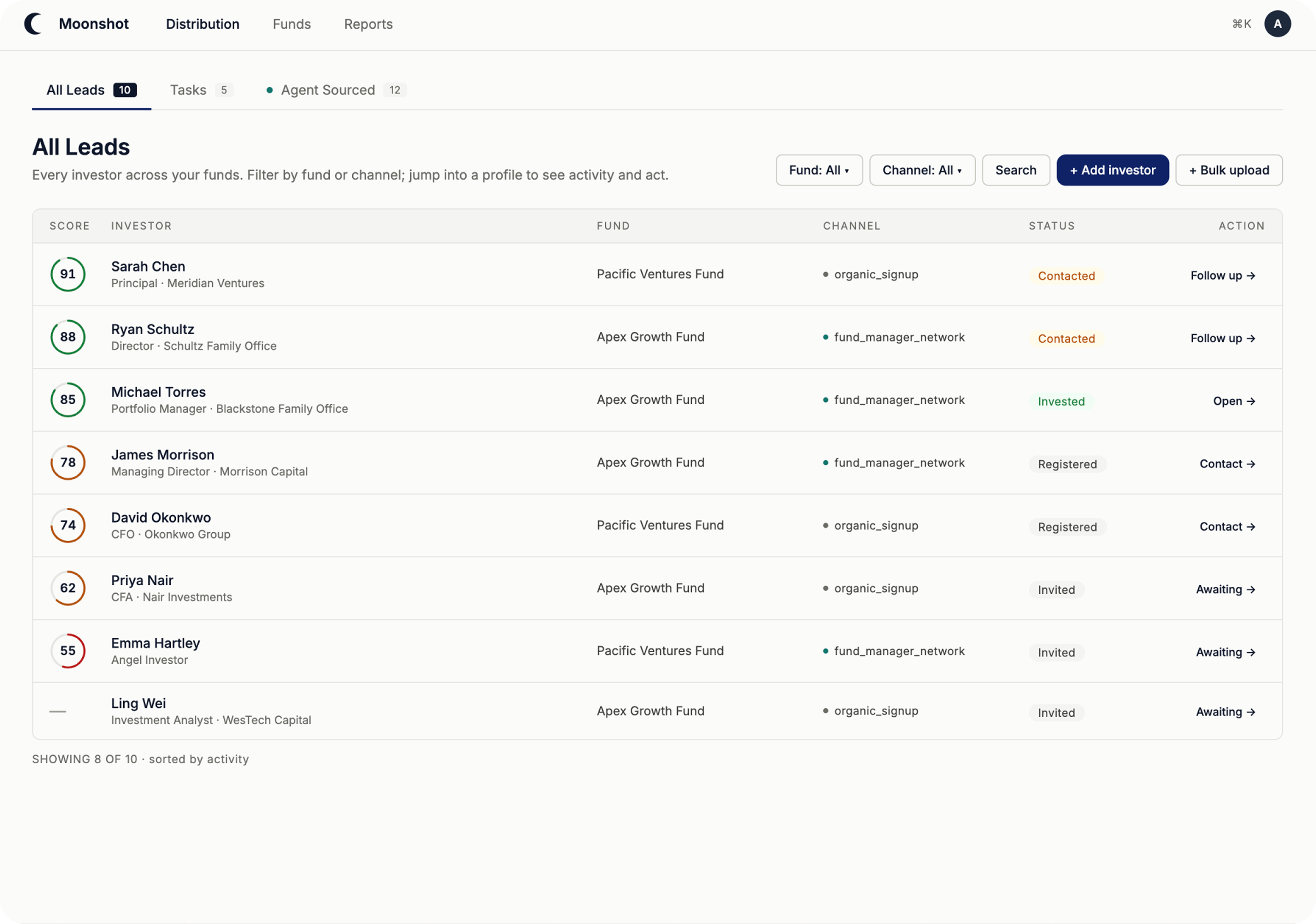
Early concepts focused heavily on AI-generated investor scores, but stakeholder feedback revealed that scores without explanation created distrust.
The experience shifted from simply displaying rankings to exposing the reasoning behind each score — helping fund managers understand why a lead was considered a strong fit before acting on it.
Scores also updated dynamically based on investor engagement, transforming the platform from a static database into a live prioritisation tool.
Prioritised leads · Lyrebird Climate Fund
Live · 142 leadsA · Reasoning
Hover any score to see the factors behind it — sector match, ticket size, recent activity.B · Live updates
Scores update as investor engagement comes in. Never static.C · Signals
Behavioural signals surfaced alongside the score, not buried.D · Action prompt
The next action is offered, not just the data.Priya Raman
Why this score
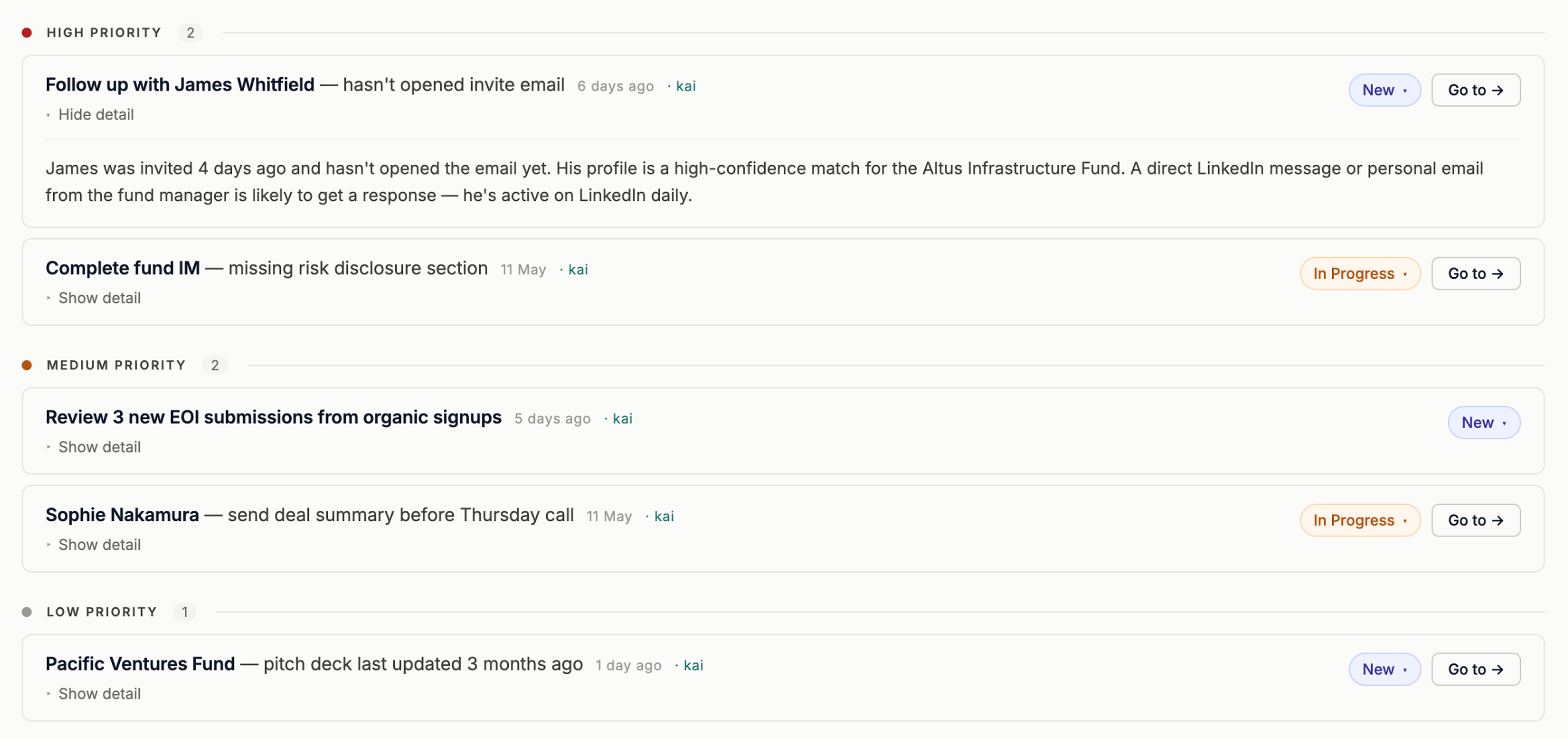
Balancing guidance without overload.
The platform had a lot to say: new leads, engagement signals, stale campaigns, missing setup. The design challenge was surfacing just enough — a short ranked action list instead of a firehose.
Review, don't transcribe.
Fund managers don't start from a blank form. They start from a PDS or IM — a document that already contains every detail the wizard asks for. Re-typing it is the worst part of the job.
Uploading the document triggers Kai to extract the fund name, structure, fees, minimum investment, target return, and distribution schedule, then prefill the wizard. Fund managers review and edit rather than transcribe. Kai works in the background — the wizard chrome stays clean.

1 — Fund manager uploads the PDS or IM

2 — Kai extracts fund structure, fees and terms

3 — Fund manager reviews and edits — no transcription
Navigating compliance & stakeholder tension.
Because the product operated in a regulated financial environment, language became a significant design consideration. Terms like “matching” or “recommended investors” raised concerns around DDO obligations and how investor suitability could be interpreted legally.
This created an ongoing tension between moving quickly as a startup, building commercially valuable AI workflows, and keeping language and interactions operationally safe and defensible. A large part of the design process involved translating complex backend logic into experiences that felt both useful and compliant.
A · Matching language
“Matched” implied a fund-manager guarantee. “Relevant” reflects that the platform is surfacing a signal, not promising suitability.
B · Score framing
“Recommended” reads as advice. “Fit score” with visible reasoning shifts authority back to the fund manager.
C · Confidence cues
Personalised language pretends to know the user. Explicit factor counts ground the score in evidence the manager can audit.
From matching interface, to scalable distribution platform.
Early concepts focused primarily on matching existing VentureCrowd investors with relevant funds. Following stakeholder review, the product direction expanded into a broader AI-assisted distribution workflow — focused on sourcing and prioritising investors outside VentureCrowd's existing network.
The interface had to grow with the model: from a single-screen match view to a full workspace for sourcing, prioritising, engaging, and learning.
Outcomes
What we shipped, and what it changed.
Moonshot shipped as a fully functional product — live within a VentureCrowd fund case study, ready for business distribution strategy. Impact ran across product, organisation, and craft.
A · Speed & culture
Speed & culture
- We shipped an end-to-end AI platform in a regulated financial services market — in weeks, with a team of two
- Proved that fintech product cycles don't have to take months with the right tools and culture
- Established a repeatable design-to-code model that removes the handoff gap entirely
- Named internally as a cultural signal — proof that VentureCrowd could move at a different pace
B · Product impact
Product impact
- Reduced the operational complexity of investor sourcing and campaign distribution
- Enabled fund managers to set up and manage a fund workflow in under an hour
- Introduced AI-assisted investor discovery and prioritisation into VentureCrowd's ecosystem
- Foundation for personalised investor discovery — stronger profiles surface increasingly relevant opportunities
C · Craft & capability
Craft & capability
- Shipped production-ready React and Next.js frontend with no prior experience — learned by doing in a live codebase
- Designing in code eliminated the translation gap between intent and implementation
- First end-to-end product shipped in a regulated AI fintech environment